
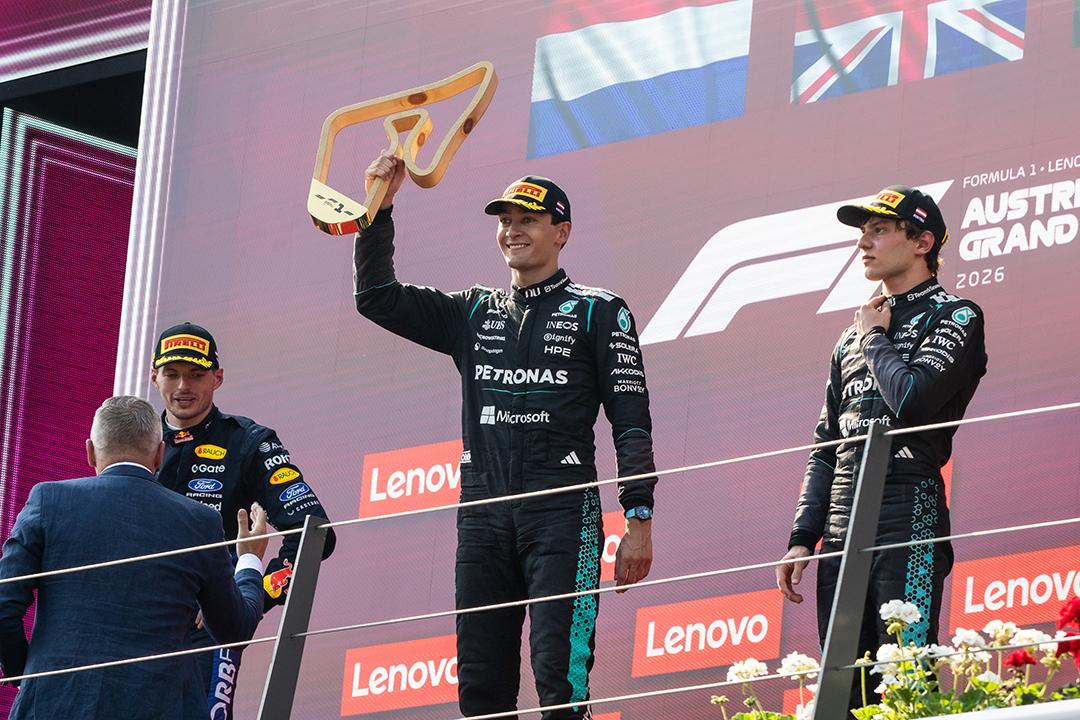
Austria Delivers a Twist as Russell Closes the Gap in the Championship
The battle for the 2026 Formula 1 championship has taken on a new level of intensity after an impressive performance from George Russell at the Austrian Grand Prix.
Delivering a calm and calculated drive at the Red Bull Ring, the Mercedes star held off relentless pressure from Max Verstappen to claim a hard-earned victory, while teammate and championship leader Kimi Antonelli completed the podium in third. The result breathed fresh energy.
For Russell, this victory represented much more than another trophy. It marked the end of a lengthy wait since his opening-round triumph in Australia and rewarded months of persistence through frustrating weekends. During that period, results often failed to reflect his effort, while Antonelli consistently impressed with remarkable maturity and speed.
Rather than accepting defeat, Russell and Mercedes searched for answers. Engineers carefully studied telemetry, race data, and driving techniques to understand why the Briton struggled to match his teammate's pace. Their findings revealed that the new generation of Formula 1 cars demanded a completely different approach, particularly when managing tire wear on circuits with limited grip.
Instead of relying on habits developed over previous seasons, Russell adapted his style to suit the characteristics of the 2026 machine. The adjustments proved highly effective in Austria, where tire preservation became one of the deciding factors.
Could this breakthrough become the turning point that changes the entire championship?
While Russell celebrated, Antonelli experienced one of his most difficult weekends of the season. A misunderstanding during qualifying saw the young Italian abandon a potentially front-row lap after misreading the yellow flag situation. The mistake dropped him further down the grid and complicated his race before the lights had even gone out.
His opening laps added more frustration as ambitious overtaking attempts forced him off the racing line several times. Even so, Antonelli demonstrated exactly why he remains the championship leader. Once he settled into his rhythm, his pace was exceptional, and he rapidly reduced the gap to the leaders during the closing stages. Despite the setbacks, he finished less than two seconds behind Russell, proving that his raw speed remains among the best on the grid.
The championship standings have tightened as a result of the Austrian race. Russell has reduced the points deficit and climbed back into a stronger position among the title contenders. With fourteen races still remaining, momentum could become just as valuable as outright speed. Will this renewed confidence allow Russell to mount a genuine challenge over the second half of the season?
Another talking point was Ferrari's unexpected lack of competitiveness. After showing encouraging pace in recent events, both Charles Leclerc and Lewis Hamilton struggled to keep up with Mercedes throughout the race. Tire degradation and outright speed prevented them from challenging for victory, highlighting how quickly the competitive order can shift from one circuit to another.
Formula 1 has always rewarded teams that learn and evolve faster than their rivals. Austria demonstrated that even experienced drivers must constantly reinvent themselves when regulations change. Russell embraced that challenge, and his willingness to adapt delivered immediate results.
The championship is far from settled. Every race now carries greater significance, every point matters, and every strategic decision could influence the outcome.
Image credit: Cristiano Barni
Instagram